Alphonse Daudet windmill in Fontvieille: the mill, Château de Montauban and Letters from My Windmill
In short: The Alphonse Daudet windmill in Fontvieille is the Moulin Saint-Pierre, built in 1814 on a hill above the village. Daudet never lived or wrote in it. The exterior is free all year; from July 2026 only the lower hall opens, for €2.50. His museum is at the nearby Château de Montauban.
Updated 20 November 2026 by Fontvieille Village Guide editors
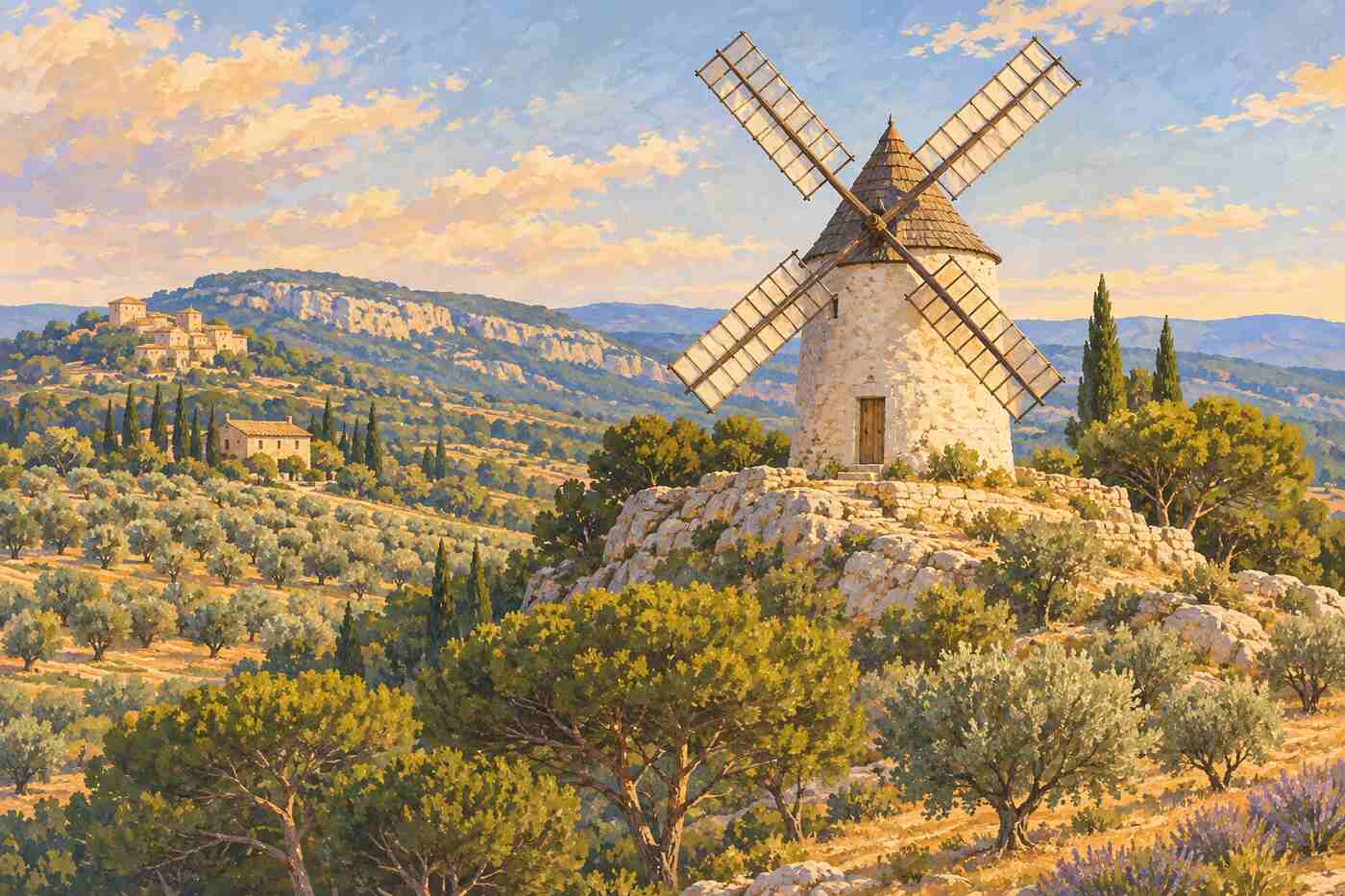
The Alphonse Daudet windmill in Fontvieille is the most visited sight in this small Alpilles village, and also the most misunderstood. The mill on the hill is real, it is listed as a historic monument and you can walk up to it in half an hour. But the writer did not own it, did not live in it and did not write Letters from My Windmill inside it. This guide explains what the mill actually is, where Daudet really stayed, how to walk the mills trail and what is open in 2026. It draws on the town hall of Fontvieille, the regional tourist board, French Wikipedia, the Fédération des Moulins de France and independent travel guides, and names them where they disagree. For the village itself, see our Fontvieille village guide.
Some definitions. A moulin is a mill; the Fontvieille mills are tower windmills that ground wheat into flour. MH stands for monument historique, the French state list of protected buildings. The Lettres de mon moulin (Letters from My Windmill) is a collection of short stories by Alphonse Daudet, set in an imagined Provence. A mas is a Provençal farmhouse or estate.
Who was Alphonse Daudet?
Alphonse Daudet was a French novelist, born in Nîmes on 13 May 1840 and died in Paris on 16 December 1897, according to Wikipedia. He worked as one of the secretaries of the Duc de Morny until Morny’s death in 1865, and his best-known works include the Lettres de mon moulin and Tartarin de Tarascon (1872). Ryo notes that he grew up in a poor family, became a junior teacher in Alès at 17 and moved to Paris at 20.
His link with Fontvieille came through family. NextOnTrip says Daudet returned to the area between 1860 and 1891 at the invitation of his cousin Louis and Louis’s wife Octavie, who lived at the Château de Montauban. Wikipedia adds a note of caution: some critics have argued that Daudet exaggerated his ties to Provence to help his literary career, following the success of the poet Frédéric Mistral.
The real history of the Moulin Saint-Pierre
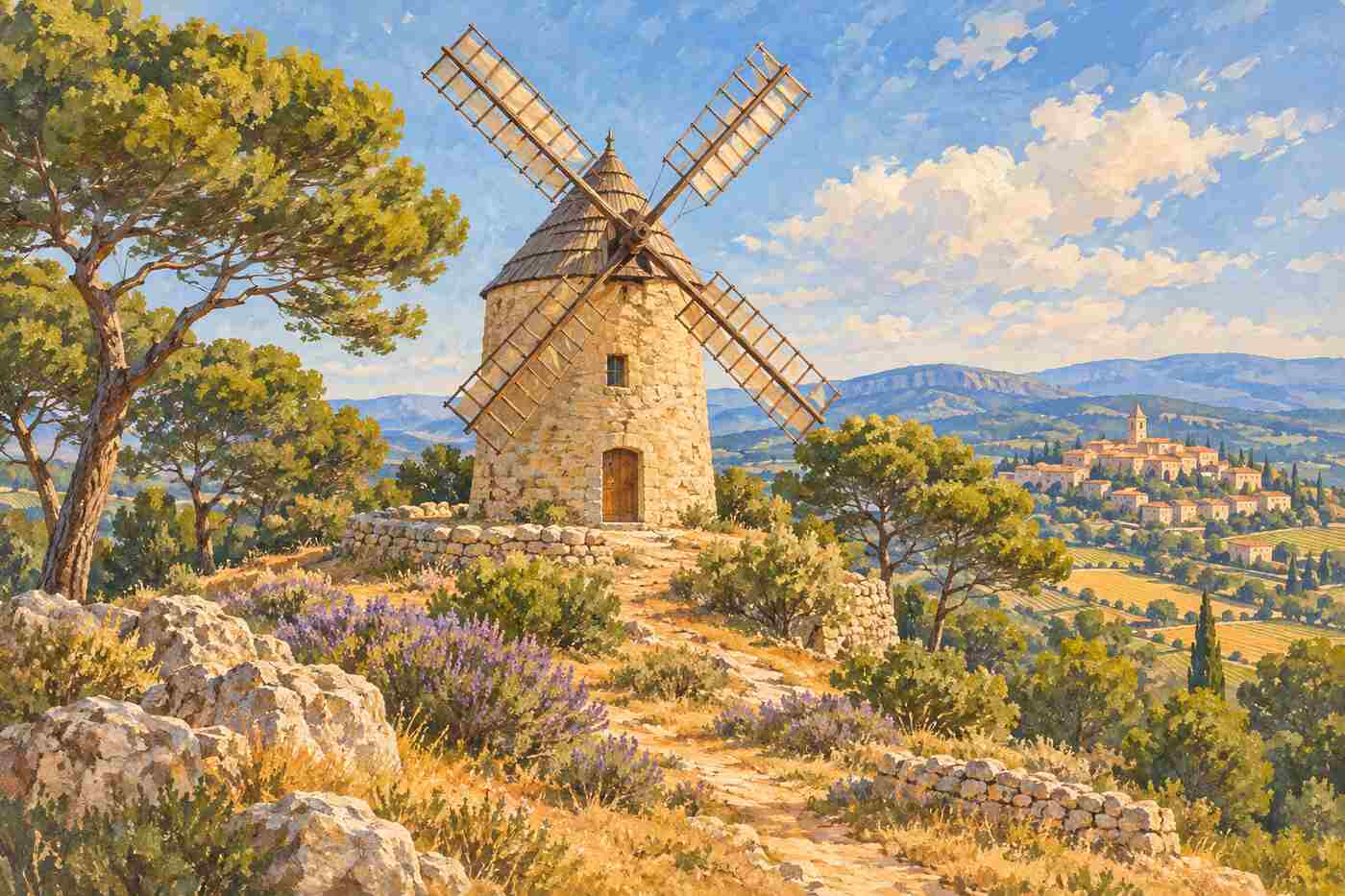
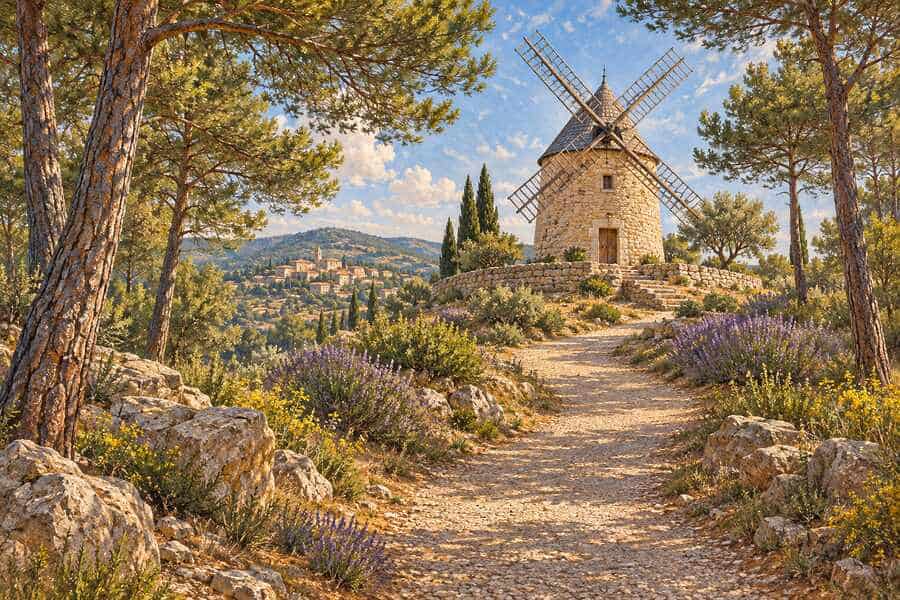
The windmill that carries Daudet’s name is the Moulin Saint-Pierre, also called the Moulin Ribet. French Wikipedia dates it to 1814 and says it ground wheat until 1915, when grain was requisitioned for the war. It was classified as a historic monument on 6 March 1931 and restored in 1935 by the Amis d’Alphonse Daudet, a society of the writer’s admirers, who turned it into a small museum.
The Fédération des Moulins de France gives its size as 5.60 m high and 6 m in diameter, with a single door, and says it was bought in 1923 by Hyacinthe Bellon. The Chemins des Parcs walking guide calls it the newest of the four Fontvieille mills and the best preserved, which is why it became “Daudet’s windmill”. Ryo adds that the hill had about ten windmills in the 18th century.
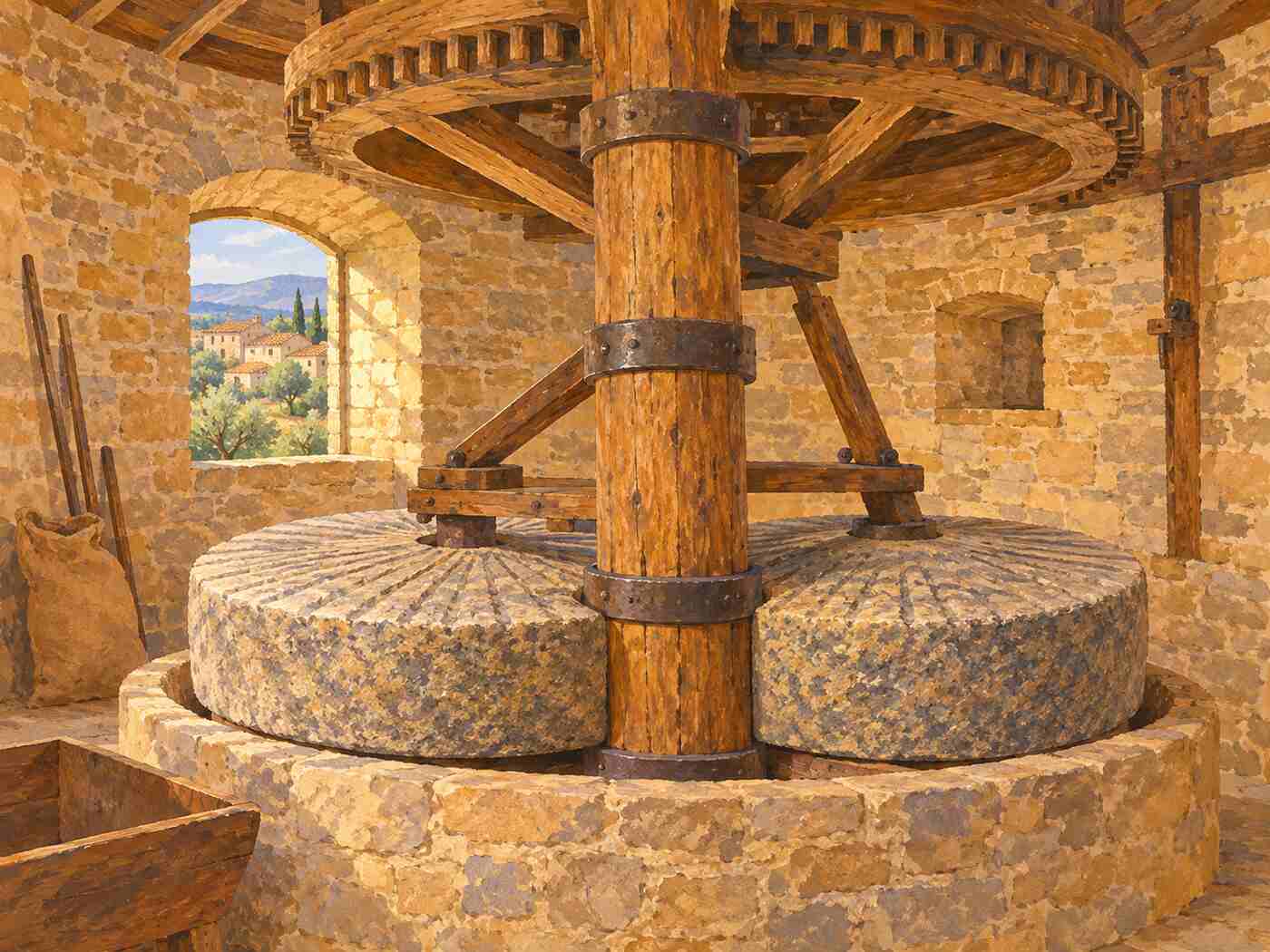
Inside, according to Ryo, the two-storey tower has a pair of granite millstones turned by an oak shaft connected to the sails, a hopper for the grain on the upper floor and a cap that the miller turned into the wind with a pole. The mechanism is complete but no longer worked.
Letters from My Windmill: what is true about Daudet and the mill
The book is fiction, and the mill is a literary backdrop. The regional tourist board states that Daudet never lived in or owned the mill. Ryo says the stories were published in serial form from 1866 and collected by the publisher Hetzel in 1869, and that Daudet wrote them in Paris and at the Château de Montauban. He often walked up to the mill to daydream, but never wrote there.
Sources differ on where the writing happened. Wikipedia places the writing in 1866 in Clamart, near Paris, while Ryo names Paris and Montauban. NextOnTrip says the earliest versions appeared in 1866 in the newspaper L’Événement under the title “Provençal Chronicles”. Ryo links five of the stories to the Fontvieille landscape, including “L’Installation”, in which the narrator takes over an abandoned mill, and “Les Deux Auberges”, about two inns on the road to Beaucaire.
The Château de Montauban and the Daudet museum
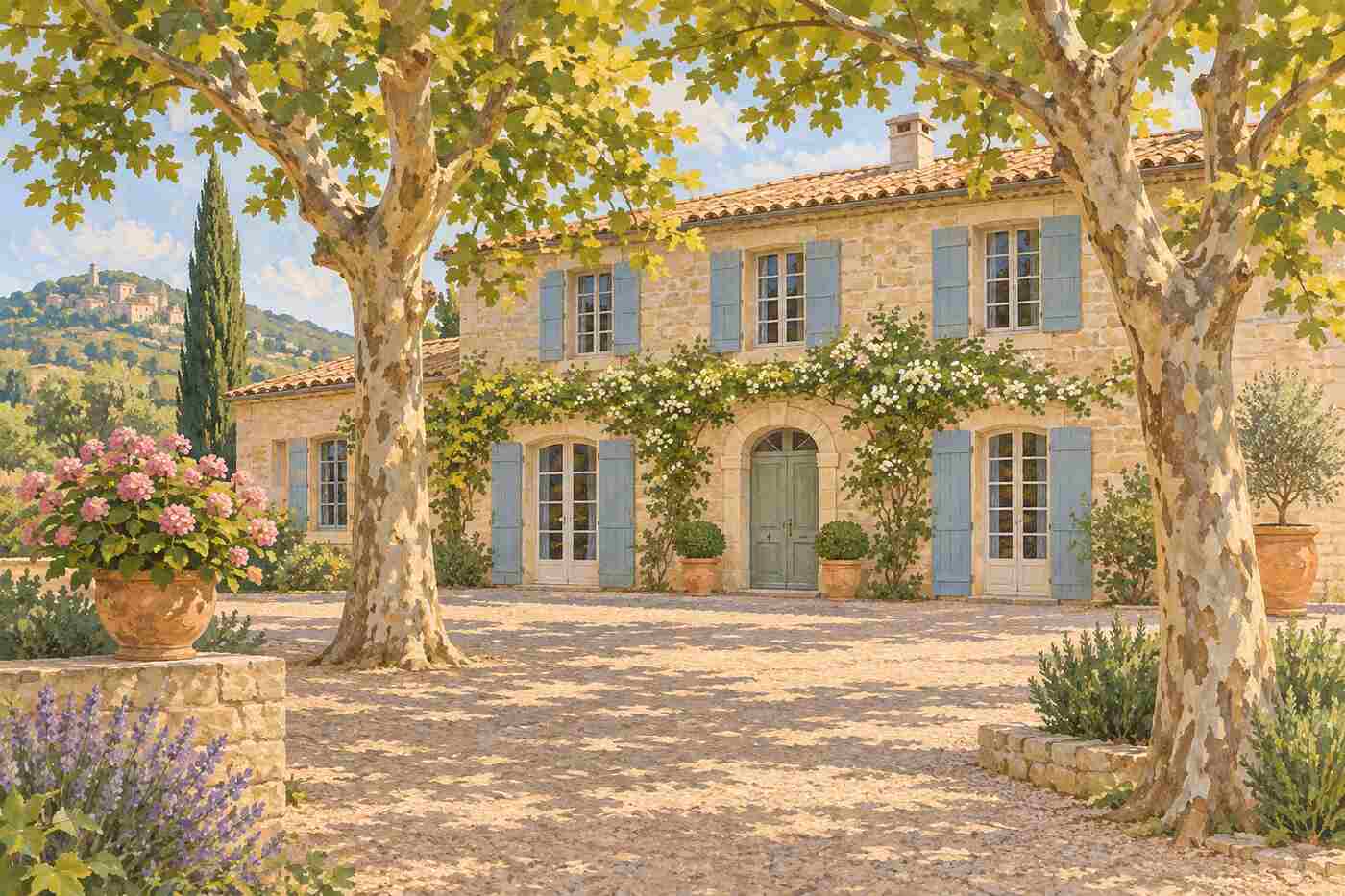
The Château de Montauban stands below the mills, close to the village centre. Horizon Provence dates it to the late 18th century and links it to the Ambroy family, Daudet’s hosts. Avignon et Provence says it houses a Daudet museum and the exhibition “Fontvieille en Histoires”, with works by the painter Léo Lelée, an Arlésienne costume and santons, the clay figures of Provençal nativity scenes. Ryo says the collections were installed in 2012 and that a full visit takes 45 minutes to an hour.
For 2025, the Fontvieille town hall press kit listed the château as open from 28 May to 5 October, Wednesday to Sunday, 10am to 1pm and 2.30pm to 6pm, at €5 full price, €3.50 reduced and €6 for a guided tour. Ryo gives an indicative €2.50, which matches the mill price rather than the château, so check the town hall figure first.
Opening hours and prices in 2026
The mill’s opening has changed several times. French Wikipedia says it closed in the 2000s when the lease ended and reopened in 2016. For 2026, sources disagree, so check before you go.
| Source | What it says about 2026 |
|---|---|
| Regional tourist board listing | From 1 July 2026 only the lower hall is open: Sunday to Thursday 11am to 6pm, Friday 11am to 1pm, closed Saturday; €2.50 |
| Martigues Tourism | “Site closed, viewing from outside only” for 2026 |
| Ryo | Interior generally closed except the Journées du Patrimoine, the third weekend of September |
| Fontvieille town hall heritage page | Opening hours 11am to 6pm |
All sources agree on one point: the exterior and the hilltop are free and open all year, so the walk is always worth doing even if the door is shut.
Walking the mills trail
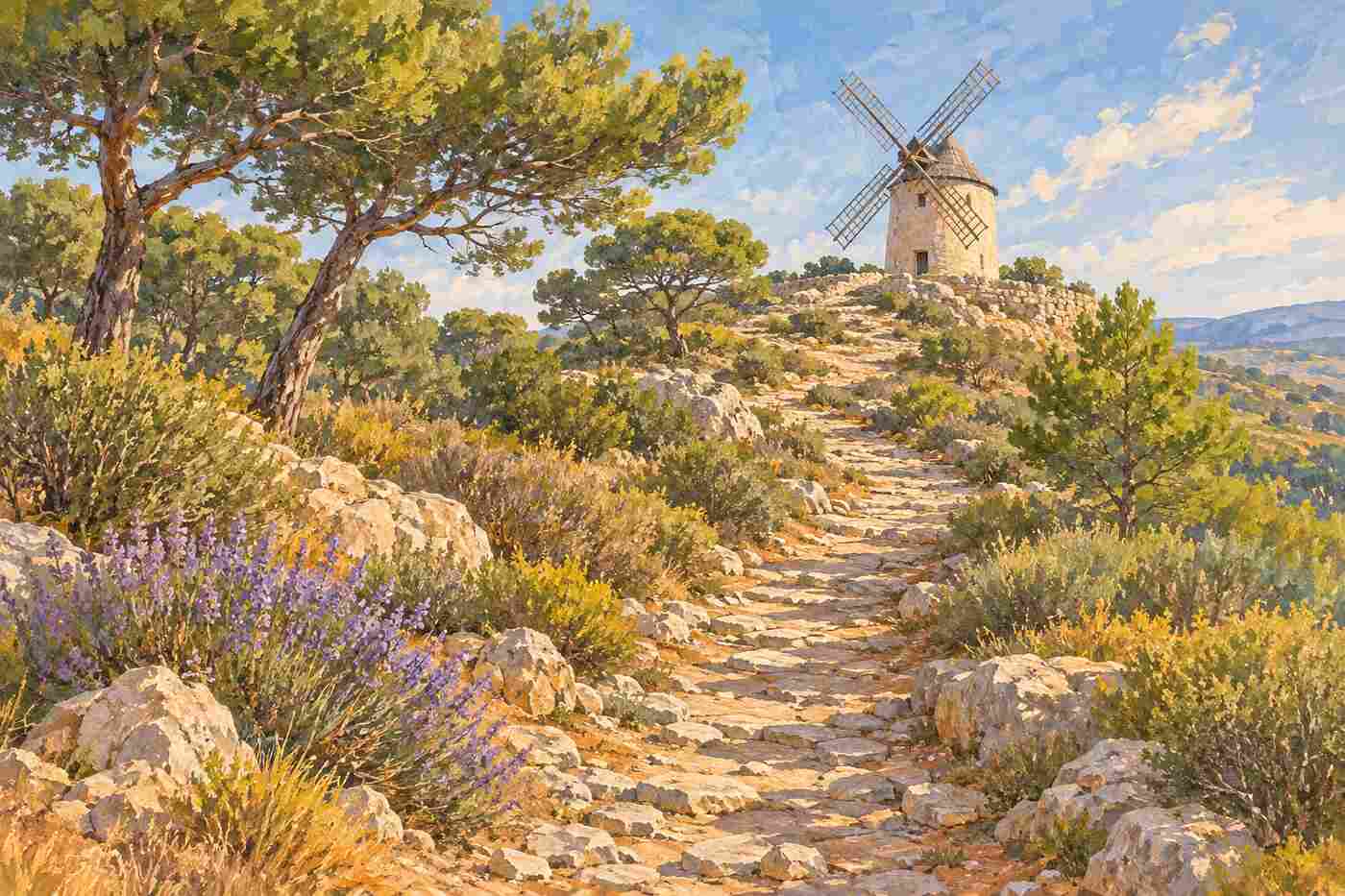
The regional tourist board describes the trail of the Moulins de Daudet as a very easy 3.8 km loop from the tourist office. It climbs past the water tower to the Sourdon windmill, continues to the Daudet windmill, then descends to the Ramet and Tissot-Avon windmills, where cart ruts are still visible on the old road. It ends at the gate of the Château de Montauban and returns past the church.
Ryo says the climb from the avenue des Moulins takes 20 to 30 minutes, with the last 150 metres stonier, and that the path is not suitable for wheelchairs. Avignon et Provence gives a 30-minute trail from the tourist office to the château and a one-hour trail from the château to the mills. In summer, Ryo advises going before 10am or after 5pm, with water and sun cream. Fire rules for the hills apply in summer; see our guide to walking in the Alpilles from Fontvieille.

Getting there and parking
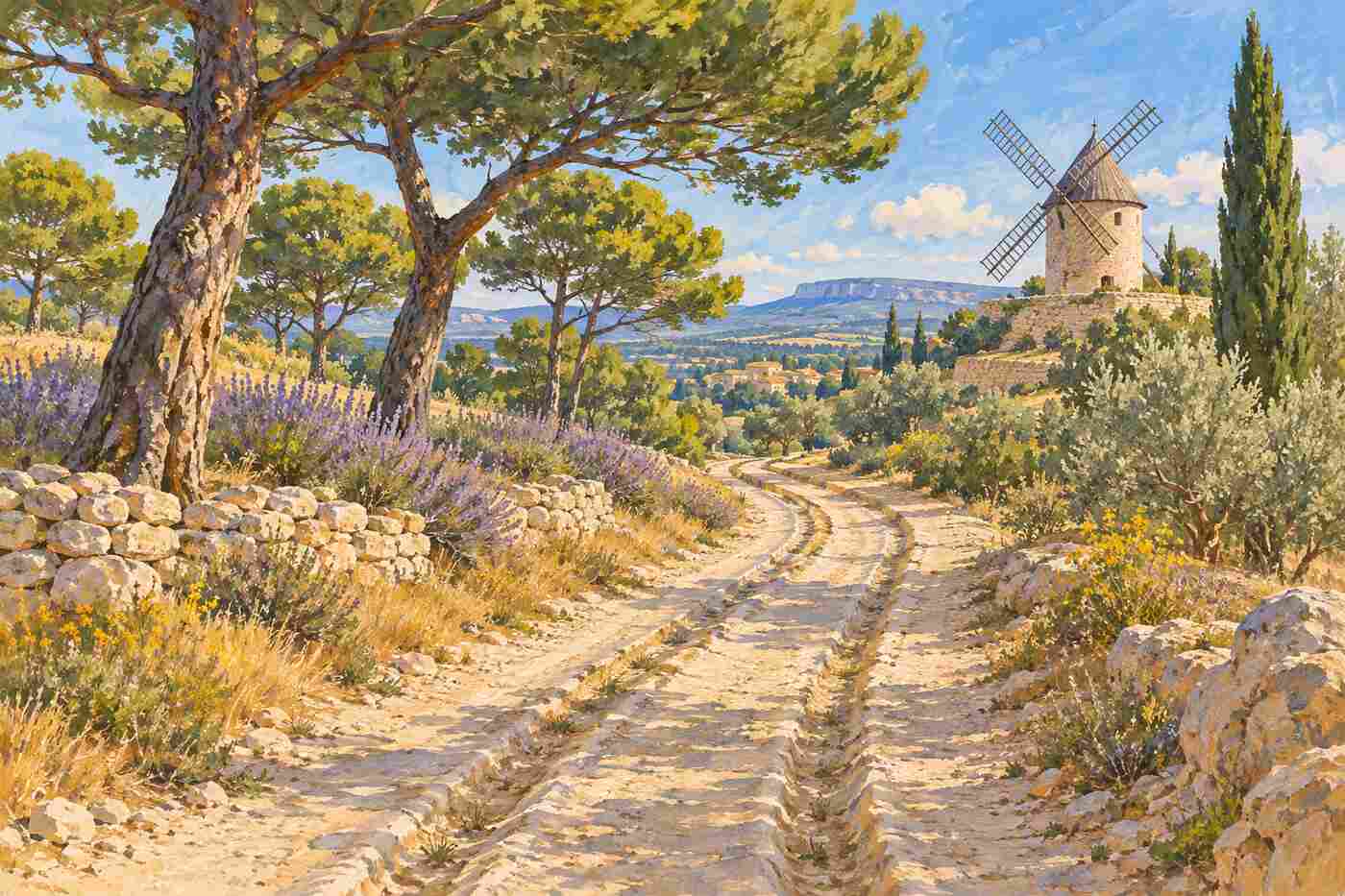
Ryo says there is free parking at the start of the mills path on the avenue des Moulins, about ten minutes’ walk from the village centre, and that it can be full by 9am in July and August. A second car park is in the village centre. Fontvieille lies about 10 km from Arles and 9 km from Les Baux, according to Horizon Provence, while Ryo gives 20 km from Arles by the D17; the gap reflects different start and end points. Regional bus line 707 links Arles and Fontvieille, according to the Zou! winter timetable.
Visiting the mill without a car
The same Zou! timetable lists three bus stops in Fontvieille, Croix Rouge, La Tour and Saint Victor, and gives 16 to 20 minutes from Arles station. Only a few buses run each day between Arles and the village, so check the return time before you set off. Bicycles can travel in the hold, up to two per bus, if you contact the operator 36 hours ahead. Our guide on how to get to Fontvieille covers the trains to Arles, the TGV via Avignon and Marseille airport.
A full day works well: the mills trail in the morning, then the bus or a short drive to Arles for the arena and theatre. See our guide to the Arles Roman monuments from Fontvieille.
Key takeaways
- “Daudet’s windmill” is the Moulin Saint-Pierre, built in 1814 and working until 1915.
- Daudet never lived in, owned or wrote in the mill; he stayed at the Château de Montauban.
- The exterior is free all year; sources conflict on interior opening in 2026.
- The 3.8 km mills trail links four windmills and the château.
- The Daudet museum is at the Château de Montauban, open in season.
Common questions
Did Alphonse Daudet live in the windmill?
No. The regional tourist board says Daudet never lived in or owned the Moulin Saint-Pierre. He stayed with relatives at the Château de Montauban, below the hill, and walked up to the mills. Ryo adds that he wrote the stories in Paris and at Montauban, and used the mill as a literary setting rather than a writing room.
Is the Daudet windmill open in 2026?
Sources disagree. The regional tourist board lists the lower hall as open from 1 July 2026, Sunday to Thursday 11am to 6pm and Friday mornings, at €2.50. Martigues Tourism says the site is closed and can only be viewed from outside. The hilltop and exterior are free and open all year, so the walk is worth it either way.
How long is the walk to the mill?
Ryo says 20 to 30 minutes uphill from the avenue des Moulins. The full signposted mills loop from the tourist office is 3.8 km and rated very easy by the regional tourist board. Allow half a day if you add the windmill site, the Château de Montauban museum and a stroll around the village.
Where is the Daudet museum?
At the Château de Montauban, Mas de Montauban, in Fontvieille, according to Ryo. It covers Daudet’s life and work, with first editions and letters, and also hosts the “Fontvieille en Histoires” exhibition, says Avignon et Provence. In 2025 the town hall listed it as open from late May to early October, Wednesday to Sunday.
Can you reach the Daudet windmill by bus?
Yes. Zou! bus 707 runs from Arles station to Fontvieille in 16 to 20 minutes, and the mills path starts on the avenue des Moulins. Buses are few, so check the timetable.
How we put this together: the mill’s history comes from French Wikipedia, the Fédération des Moulins de France and Chemins des Parcs; Daudet’s life comes from Wikipedia, Ryo and NextOnTrip, which differ on where the stories were written; 2026 hours come from the regional tourist board, Martigues Tourism and the town hall, which disagree; château hours and prices come from the town hall’s 2025 press kit. Checked 20 November 2026. Back to the Fontvieille Village Guide home page, or continue to the Barbegal aqueduct and Roman mills.
Sources
- Wikipedia (FR): Moulin Saint-Pierre
- Wikipedia: Alphonse Daudet
- Provence-Alpes-Côte d’Azur Tourism: Alphonse Daudet windmill
- Provence-Alpes-Côte d’Azur Tourism: Les Moulins d’Alphonse Daudet
- Provence-Alpes-Côte d’Azur Tourism: The trail of the Moulins de Daudet
- Fédération des Moulins de France: Moulin Saint-Pierre
- Martigues Tourism: Les Moulins d’Alphonse Daudet
- Ryo: Visit Alphonse Daudet’s windmill in Fontvieille
- NextOnTrip: Moulin d’Alphonse Daudet
- Ville de Fontvieille: Patrimoine
- Ville de Fontvieille: 2025 press kit
- Avignon et Provence: Alphonse Daudet’s windmill
- Horizon Provence: Fontvieille
- Chemins des Parcs: Les Crottes d’Aubert
- Zou!: Line 707 winter timetable